Part one of this blog looked at how the individualized education program came into existence and the process by which a child is evaluated. Part two will look at how the IEP is customized for each student and the steps taken to make sure it is being effective.
III. Designing the IEP
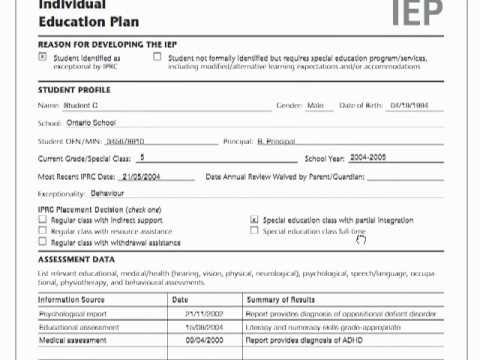 If a student is diagnosed with a disability, the next step is to design a program for him or her that addresses their unique needs. This program will be laid out in a very specific, very long document called the individual education program or IEP (pictured at right). It is reviewed annually. Just for clarification, an initial IEP must be in place within thirty (30) days following the evaluation meeting to determine eligibility; afterwards, an annual meeting must, under the terms of PL 94-142, take place no later than 365 days later. Meetings held after the 365 day benchmark are considered non-compliant.
IV. What goes into the IEP
As the old saying goes "everything but the kitchen sink". All brevity aside, keep in mind that the IEP is a binding document for the provisions of service between the district and the parents. This means that if the district does not provide the services promised in the IEP, it is non-compliant with not only the IEP, but also the law. Inside the IEP, a parent can expect to find the following:
Present levels are a snapshot of who the student is and how he/she is doing. It should include data such as reading test scores and math test scores, current grades, observed skills, behavioral referrals, and a record (or records) of work habits.
 The offer of Free and Appropriate Public Education or FAPE which is commonly referred to as "placement" and/or "services". This is the binding part of the contract - between the parents and the district - where the district offers classroom or ancillary services such as speech therapy. It should also specify how often (number of days in the school year) the student will receive these services as well as the duration (how many minutes each session will last). Variable terms such as "as needed" cannot be used in this section, rather it should specifically spell out the minimum number and times for provision of services.
Goals are written to provide a measure of progress. They can be academic, social, or behavioral and should always be written with recognized area of need in mind. These goals should be achievable and measurable (see: S.M.A.R.T. goals)
 Accommodations and modifications are changes to the classroom environment which may be necessary to assist the student (see example at left). For those who might not be familiar with the difference between these two terms, an accommodation helps a student to complete the same work on the same level as his/her peers; a modification allows for the student's work to be changed or completed on a different level.
Recent legislation mandates requires a transition plan if a student who will turn 16 years-old within the life of the IEP. The legislation also requires a transition goal in addition to the transition plan.
Typically each member of a student's IEP team signs a signature page and meeting notes that 1) Indicates their presence at the meeting; and 2) He or she approves the notes taken during the meeting. In addition, the parent(s) must consent to the accommodations, modifications, and placement (offer of FAPE) from the district for the initial IEP to be implemented.
V. What happens at the IEP meeting
As I indicated above, by law, this meeting must take place once-a-year and is designed to bring all of the team members together to discuss the student's needs as well as to review his/her performance by reviewing their progress toward stated goals. This is also when the teams reviews the student's eligibility to continue services and is known as the Triennial review and must be completed once every three years.
Just as an interesting sidebar about the IEP meeting, many new teachers are under the mistaken impression that the entire IEP must be written during this annual meeting. While some of the writing does happen during this meeting, the team should be prepared to come to the meeting with a first draft of goals, present levels, suggested accommodations, and an offer of Free and appropriate public education (FAPE).
Additional information: Individualized education program (IEP)