Showing posts with label Cerebrospinal Fluid. Show all posts

Friday, August 25, 2017

Does it hurt? Hydrocephalus and the headaches associated with it (Part 1 of 2)


The other evening I was looking at what I had written about so far and thinking of additional topics when a long-time friend suggested "anything but the typical 'does it hurt' '" that she and I have heard too much as we grew up with a disability and even now as we are in our adult years. Following her comment, I began looking and came up with the idea of doing a blog on hydrocephalus and the associated headaches suffered by some of us.

I. Mechanics of hydrocephalus and headaches

The combination of brain volume (volume for the average adult is 1,260 cubic centimeters), blood volume, and cerebrospinal fluid (CSF) volume determine intracranial pressure or ICP. If one of these increases, pressure in the brain will rise unless one of the others compensates by decreasing. In a person - such as myself - with hydrocephalus this balance is distorted and a unnatural condition takes place. In a person not affected by hydrocephalus, they should have one ounce (1 oz.) of CSF in the ventricles and about four ounces (4 oz.) of CSF surrounding the outside of the brain. When the components of the brain are functioning normally - without a shunt - the brain has the ability to be elastic. This means it is able to compensate accordingly for an increase (or decrease in CSF pressure). In hydrocephalus patient's who have been shunted, this is no longer the case.

No automatic alt text available.
Physiology of hydrocephalus
In studying to present this blog, I learned something that I had never heard before and that is that when our bodies enter rapid eye movement (REM) sleep (typically about 80 - 90 minutes after falling alseep) plateau waves occur resulting in increased intracranial pressure (ICP). In shunted patients who undergo ICP monitoring overnight, those changes are considerably more drastic that with the average person. Those things that would normally be expected to cause an increase in ICP result in huge changes in a shunted patient.

Placement of a shunt results in an unnatural situation. The brain fills the intracranial space while the shunt drains essentially of the available CSF from the ventricles.The end result is a larger-than-normal brain in a fixed (NOT elastic) skull with little room for changes in the ICP (which is characteristic of a person with hydrocephalus. If changes in blood flow occur, resulting in blood volume within the intracranial space, increased intracranial pressure will occur and can result in a headache.

Headaches can also be the result of altered pressures within the skull once a shunt has been implanted. Interestingly, the can occur both if the pressure is too high or too low.

II. Treatment

Like everyone else, both children and adults with hydrocephalus experience periodic headaches. It is the frequency and severity of these that determine whether they are a result of the hydrocephalus. According to Dr. Gordon McComb, Chief of Neurosurgery, Children's Hospital Los Angeles, "If the headaches are getting progressively worse, many times it's an intermittent malfunction of the shunt". Dr. McComb explains that ventricle size is also not always an accurate indication of whether the shunt is working correctly. "The ventricles are going to remain the exact same size whether the pressure is normal or elevated".
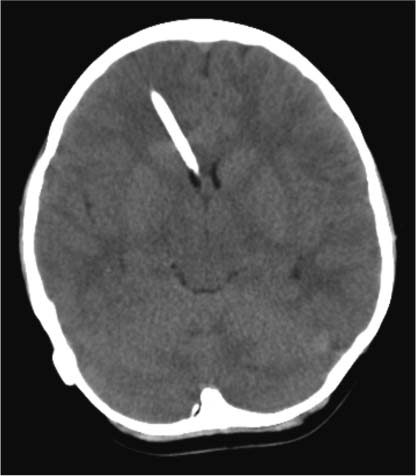
The slit ventricle is the white streak
visible pointing toward the
left side of the brain
With slit ventricle syndrome, small ventricle size is not the cause of the problem. The problem occurs if the shunt becomes clogged and the ventricles don't dilate. If this situation happens repeatedly (accompanied by acceleration in the occurrence of headaches) it can indicate a blockage the builds up and then releases. Replacing the proximal ventricular catheter in the shunt will normally correct this problem.

When hydrocephalus problems experience repeated headaches it is imperative to sketch out a plan of action which involves a conference between the patient and his/her doctor(s). This conference sets up treatment parameters and, if those parameters are exceeded, the medical team moves forward with the replacement of the shunt.


For additional information: Hydrocephalus and headaches

Monday, August 21, 2017

Shunting as a means to manage hydrocephalus


I. Overview

Image result for subarachnoid space
Subarachnoid spaces in the brain

I. Overview

Over the years, the management of hydrocephalus has challenged neurologist, engineers, and medical device manufacturer alike due to the unique nature of cerebrospinal fluid (CSF) dynamics in each person. Known as a "CSF diversion device", a shunt has become the primary therapy used in hydrocephalus management for over sixty (60) years. The shunt, which is surgically implanted within a ventricle in the patient's brain (or in the subarachnoid spaces around the brain), works by diverting the CSF to another part of the body where it is absorbed. This creation of an alternate pathway typically restores the physiological balance between CSF production, flow, and absorption when one or more of these functions has been impaired. Once it has been inserted, valves within the shunt's pathway act like on/off switches, opening when the differential pressure, that is, the pressure difference across the valve, exceeds the valve's opening pressure.
Blog author Walter Little with his
grandparents, James and Sara Sanders,
and Officer Dorsey Goss (1973)

II. What are the complications of shunting?

As I alluded to above, a shunt provides an alternate pathway through which CSF can bypass obstruction(s) in the fluid compartments (ventricles) of the brain. Such a bypass relieves the excess fluid backup the causes hydrocephalus. When both the CSF production and absorption are in balance, the hydrocephalus is considered to be "compensated". In contrast, when production exceeds aborption, complications such as elevated pressure or overdrainage occur and can mimic a malfunctioning shunt.

More detailed information can be found on the Hydrocephalus Association website, but here is a brief overview of some of the most common complications:

Malfunction

As is the case with any piece of equipment, a shunt might break. Additional they are subject to becoming disconnected, migrating (moving), or, most commonly, becoming blocked. (It should be noted that the disconnection and migration are particularly prevalent in children with a shunt due to the child's growth.)

Infection

Shunts can become colonized with bacteria or - in rare instances - fungi which typically occurs at the time the shunt is implanted. In an effort to combat this, some manufacturers have began to add anti-microbial coating to their shunts which appears to be reducing the rate of post-surgical infection.

Material degradation

Originally, barium sulfate (BaSO4) was mixed with silicone to allow the shunt catheter to be visible on an x-ray. These would eventually dissolve making the tubing surface rough. When tissue in-growth occurred to the tubing, it would bind at that location resulting in deterioration and/or breakage. Over time the design of shunt tubing has changed and a clear silicone elastomer now covers the surface of the tubing greatly decreasing the likelihood of degradation.

 Shunt revision(s)

I put an "s" on revision because the average person with hydrocephalus undergoes 2.66 shunt revisions over the course of their lifetime. These can be required at any time to correct one (or more) of the complications outlined above or to compensate for growth in the case of children and young adults. If a blockage is suspected, it must be confirmed by a neurosurgeon who evaluates the implanted system to determine whether the problem is the result of a complete or partial blockage, if a disconnection has occurred, or whether the current system just can't no longer meet the needs of the individual.

Additional information:

Shunt system fact sheet

Thursday, August 17, 2017

What is hydrocephalus? (Part 1 of 2)


Countdown to Washington: 3 weeks and four (4) days

I. What is hydrocephalus?
Taken shortly after my birth,
my hydrocephalus was clearly evident

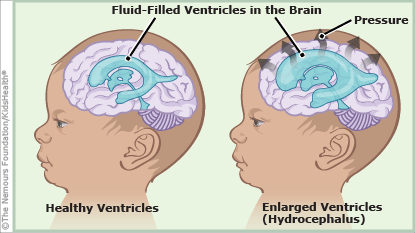
After completing my latest blog last night, it occurred to me that some might not know and/or understand what hydrocephalus is. It is a condition caused by an abnormal accumulation of cerebrospinal fluid (CSF) in the ventricles (pictured above) of the brain.  The word comes from the Greek hydro (meaning "water") and cephalus (meaning "head). Often, the term "water head" is used in a derogatory sense to make fun of a person suffering from the condition.

Under normal conditions the CSF - which is produced in the ventricles - circulates through the ventricular system before being absorbed into the blood stream. It is constantly being circulated and serves many functions in ensuring the health of both the brain and the spinal cord. Perhaps one of its most important functions is to surround both the brain and spinal cord and serve as a cushion against injury. In persons with hydrocephalus (or "hydro" for short) there is an imbalance between the amount of CSF produced and the rate at which it is absorbed into the blood stream. As it builds up within the ventricles, it causes them to enlarge and the pressure to increase.

II. What causes hydrocephalus?

First of all, it's important to differentiate that hydrocephalus is a condition and not a disease  (emphasis added) as I have heard people mistakenly say over the years. It can develop for a variety of reasons including as a part of another condition.

Hydrocephalus that is congenital (meaning that it is present at birth as mine was) is thought to be the result of a complex interaction of both genetic and environmental factors. One of the most common causes of hydrocephalus is Aqueductal stenosis where there is a blockage of the cerebral aqueduct known as the Aqueduct of Sylvius.  It is estimated that hydrocephalus occurs in 1.5 per 1,000 births.

In addition to congenital hydrocephalus, it can also be acquired as the result of intraventricular hemorrhage, meningitis, head trauma, a tumor, or a cyst.

Yet a third cause of hydrocephalus - known as normal pressure hydrocephalus or NPH - is prevalent in older adults. Unlike congenital or acquired hydrocephalus, NPH causes little or no appreciable increase in pressure within the ventricles.


For additional information: Hydrocephalus fact sheet