Showing posts with label Congenital. Show all posts

Thursday, February 8, 2018

What is congenital aqueductal stenosis and hydrocephalus? (Part 2)

How is it diagnosed?

A diagnosis of hydrocephalus resulting from congenital stenosis of the aqueduct of Sylvius is typically suspected based on the presence of characteristic signs and symptoms (found in a physical exam) and/or imaging of the brain. Evidence of a mutation in the L1CAM gene can be used to confirm the diagnosis

How is it treated?

The treatment of HSAS is dependent on the signs and symptoms presented by each individual. For example, in persons with hydrocephalus, treatment involves brain surgery to implant a shunt. If it causes the child to have intellectual disabilities, a combination of early intervention and enrollment in special education classes might be recommended.


BIBLIOGRAPHY


National Institutes of Health (N.D.) Hydrocephalus due to congenital stenosis of aqueduct of Sylvius. Retrieved on February 7, 2018 from https://rarediseases.info.nih.gov/diseases/434/hydrocephalus-due-to-congenital-stenosis-of-aqueduct-of-sylvius

National Institutes of Health (2018). L 1 syndrome. Retrieved on February 7, 2018 from https://ghr.nlm.nih.gov/condition/l1-syndrome.

Online Mendelian inheritance in men (OMIM) (ND). MASA syndrome. Retrieved on February 7, 2018 from http://www.omim.org/entry/303350.

Wednesday, February 7, 2018

What is congenital aqueductal stenosis and hydrocephalus? (Part 1)

In yesterday's blog - as well as a blog I wrote last year - I touched on aqueductal stenosis. Today, I want to look at congenital aqueductal stenosis and how it causes hydrocephalus. This is a condition that is "near and dear" to me because I found out back in October that I suffer from the condition. Most likely, according to the neurosurgeon, that is what caused my hydrocephalus.

What is hydrocephalus due to congenital aqueductal stenosis (HSAS)?

Hydrocephalus due to congenital aqueductal stenosis (HSAS) is a form of L1 syndrome -- a group of conditions that primarily affects the nervous system and occurs almost exclusively in males. They (L1 syndrome disorders) can vary in severity and include, from most severe to least severe, x-linked hydrocephalus with aqueductual stenosis (HSAS), Spastic paraplegia 1, and x-linked complicated corpus callosum agenesis.

HSAS is an acronym for the characteristic features of the condition: a buildup of cerebrospinal fluid (CSF) in the brain (hydrocephalus) which is often present from birth, muscle stiffness or spasticity, adducted thumbs (meaning they are permanently bent inward toward the palms), and a narrowing (stenosis) of the aqueduct of Sylvius.

How is HSAS passed from parent to child?

HSAS is inherited in an X-linked recessive manner. This means the responsible gene is located on the X chromosome -- one of two sex chromosomes; the other sex chromosome is the Y chromosome. Females have two (2) X chromosomes in each cell while the male has an X chromosome and a Y chromosome in each cell.

One of the female's X chromosomes is "turned off" meaning all of the genes on that chromosome are inactive. If a female has a change (mutation) in the gene on one of their X chromosomes, she is considered to be a carrier but will not exhibit the symptom(s) associated with the mutation. In those rare cases, where the female does experience symptoms, they are generally milder than those experienced by the males. In contrast, a male has only one (1) X chromosome, so, if he inherits a mutation on that chromosome, he will be symptomatic.

Thursday, August 17, 2017

What is hydrocephalus? (Part 1 of 2)


Countdown to Washington: 3 weeks and four (4) days

I. What is hydrocephalus?
Taken shortly after my birth,
my hydrocephalus was clearly evident

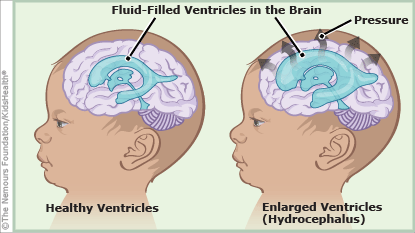
After completing my latest blog last night, it occurred to me that some might not know and/or understand what hydrocephalus is. It is a condition caused by an abnormal accumulation of cerebrospinal fluid (CSF) in the ventricles (pictured above) of the brain.  The word comes from the Greek hydro (meaning "water") and cephalus (meaning "head). Often, the term "water head" is used in a derogatory sense to make fun of a person suffering from the condition.

Under normal conditions the CSF - which is produced in the ventricles - circulates through the ventricular system before being absorbed into the blood stream. It is constantly being circulated and serves many functions in ensuring the health of both the brain and the spinal cord. Perhaps one of its most important functions is to surround both the brain and spinal cord and serve as a cushion against injury. In persons with hydrocephalus (or "hydro" for short) there is an imbalance between the amount of CSF produced and the rate at which it is absorbed into the blood stream. As it builds up within the ventricles, it causes them to enlarge and the pressure to increase.

II. What causes hydrocephalus?

First of all, it's important to differentiate that hydrocephalus is a condition and not a disease  (emphasis added) as I have heard people mistakenly say over the years. It can develop for a variety of reasons including as a part of another condition.

Hydrocephalus that is congenital (meaning that it is present at birth as mine was) is thought to be the result of a complex interaction of both genetic and environmental factors. One of the most common causes of hydrocephalus is Aqueductal stenosis where there is a blockage of the cerebral aqueduct known as the Aqueduct of Sylvius.  It is estimated that hydrocephalus occurs in 1.5 per 1,000 births.

In addition to congenital hydrocephalus, it can also be acquired as the result of intraventricular hemorrhage, meningitis, head trauma, a tumor, or a cyst.

Yet a third cause of hydrocephalus - known as normal pressure hydrocephalus or NPH - is prevalent in older adults. Unlike congenital or acquired hydrocephalus, NPH causes little or no appreciable increase in pressure within the ventricles.


For additional information: Hydrocephalus fact sheet